How to Check If ChatGPT Recommends Your Brand (A Free 15-Minute Audit)
Most brands have never checked what AI actually says about them. Here are three prompts that reveal whether ChatGPT recommends you — and how to read the answers.
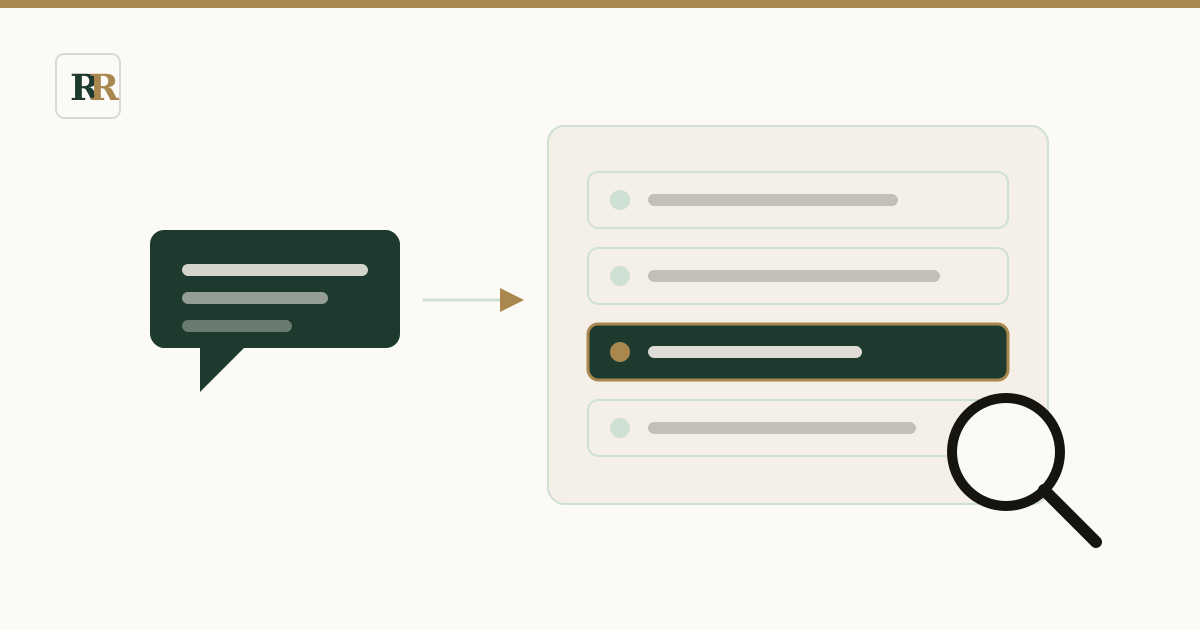
To check if ChatGPT recommends your brand, open a new chat, ask it to recommend the best providers in your category and city, and see whether you appear. Run the same prompt three times, because the answers vary. If your brand never surfaces, you are invisible at the exact moment a buyer is asking for a shortlist — and no amount of keyword ranking fixes that on its own.
That audit takes about fifteen minutes. Almost nobody runs it. Below are the three prompts worth running, what to record, and how to read what comes back.
Why This Matters More Than Your Ranking Position
A traditional search result gives the buyer ten options and lets them choose. An AI answer gives them three, already filtered, with reasons attached. The shortlist is the decision for a growing share of buyers.
This is a different competition than ranking. You are not trying to be position one on a results page — you are trying to be one of a handful of brands the model considers credible enough to name. Those are related problems, but they are not the same problem, and the second one is measurable in a way most teams have never bothered to measure.
Prompt 1: The Category Prompt
Ask the question a buyer with no shortlist would ask:
What are the best [your category] companies in [your city or market]?
This is the blunt instrument, and it tells you whether you exist in the model's answer at all. Run it three separate times in three fresh chats. Do not refine it, do not add context, and do not tell the model who you are — the moment you name your brand, you have contaminated the test.
Record which names appear, in what order, and how many of the three runs each name survives. A brand that appears in all three runs holds a genuinely durable position. A brand that appears once may have been noise.
Prompt 2: The Comparison Prompt
Now ask the question a buyer asks once they have a shortlist:
Compare [your brand] and [your closest competitor]. Who should I choose and why?
This one is uncomfortable, and it is the most useful of the three. You are no longer testing whether you are visible — you are testing what the model believes about you. Read the answer for three things: whether the facts about you are correct, whether the framing is flattering or damning, and what evidence the model reaches for to justify its verdict.
Wrong facts here are a live problem. If the model has your pricing model, your service area, or your specialism wrong, it will repeat that error to every buyer who asks.
Prompt 3: The Objection Prompt
Ask the question a skeptical buyer asks:
What are the downsides or common complaints about [your brand]?
Whatever comes back is what a motivated buyer will see when they do their diligence. Sometimes the answer is a fair summary of real feedback. Sometimes it is a hallucinated concern the model has generalised from your category. Both are worth knowing, and only one of them is fixable by improving your service.
How to Read the Answers
Do not just note whether you appeared. Record the sources. Most AI answers will either cite their references directly or name them in passing, and the pattern in those citations is the single most actionable thing the audit produces.
Three questions to answer from your notes:
- Which sources did the model lean on? Directories, review platforms, industry press, forum threads — the mix tells you where your visibility is actually being decided.
- Did your own website appear anywhere? For most brands the honest answer is no. When we ran this experiment across five cities, not a single answer sourced a firm's own website.
- What did the named brands have that you do not? Usually it is not better copy. It is presence on the sources the model trusts, depth of reviews, and demonstrable results published somewhere other than their own homepage.
Turning the Audit Into a Fix
The audit tells you where you stand. Acting on it is a separate discipline, and it splits cleanly in two.
Off-site work gets you considered. That means being present and accurate on the directories and review platforms your category is judged by, earning mentions in places that get cited, and building a review profile with enough depth that it reads as evidence rather than decoration.
On-site work gets you cited. That means pages that answer questions directly in the opening lines, structure that a model can parse and quote without ambiguity, and original material — data, results, specifics — that nothing else on the web can substitute for. Our technical SEO audit checklist covers the foundations that have to be in place before any of this is worth attempting.
Both matter. Neither works alone.
Run It Monthly, Not Once
AI citations are not stable. A brand cited consistently one month can drop out the next as models update, sources shift, and competitors invest. This is the part most teams get wrong: they run the audit once, screenshot a good result, and treat it as a finish line.
Treat it as a recurring measurement instead. Same three prompts, same three runs, same day each month, logged somewhere you can compare over time. The trend line is worth far more than any single snapshot — and it is the only way to tell whether the work you are doing is moving anything.
The Wider Shift
None of this replaces search fundamentals. It sits on top of them. The brands doing well in AI answers are, almost without exception, the brands that did the unglamorous work first: clean technical foundations, genuine authority signals, and content with something in it worth quoting.
What has changed is that the reward now arrives through a channel most teams are not watching. AI search visibility is measurable, it moves, and it responds to deliberate work — but only if someone is actually looking at it.
If you would rather not run this manually every month, see how we track AI visibility as a continuous signal rather than a one-off check.