How to Get Your Brand Cited in Perplexity Answers
Perplexity answers from live web retrieval, so fresh, crawlable, answer-first pages get cited. Here is the checklist and a test you can run on your own brand.
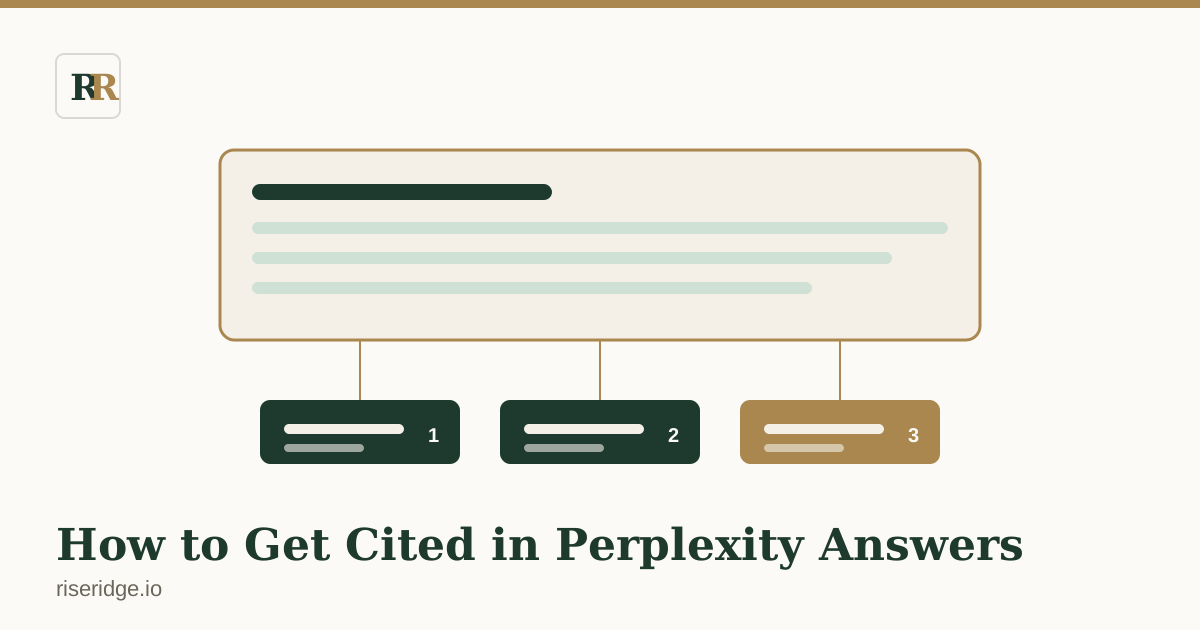
To get cited in Perplexity, your page has to be reachable by its crawler, rank for the sub-questions Perplexity searches on your behalf, and contain a short, specific passage that answers the question on its own. Perplexity retrieves pages from the live web for each question and then writes an answer with numbered source links. Unlike a model that answers from memory, it can pick up a page you published last week.
This guide covers how Perplexity chooses sources, a practical checklist, how to test your own brand, and the mistakes that keep pages out of its answers. No one outside Perplexity knows its exact ranking logic, so everything below is a working method to test, not a guarantee.
How Does Perplexity Choose Which Sources to Cite?
Perplexity runs a web search for the question, reads the pages it retrieves, and composes an answer that links back to the pages it used. Three things follow from that design:
- Retrieval comes first. If your page is not found by the search step, it cannot be cited, however good the content is.
- Freshness matters more than in a model-only answer. The pages are fetched at question time, so recently updated pages compete on equal terms with older ones.
- The answer is assembled from passages. A clear paragraph, table row or list item is easier to use than a point spread over several sections.
Perplexity also tends to cite third-party pages that discuss a category: listicles, comparison posts, directories and review sites. When someone asks "best X for Y", your own site is often not the page that gets cited. A page that mentions you can be.
The same pattern shows up in other AI search products, which is why we treat this as one problem with product-specific details. If you want the wider frame, read our guide to AI search visibility and our explanation of what generative engine optimization is.
Can Perplexity Crawl Your Site?
Check this first, because it is the cheapest problem to fix. Perplexity uses its own user agents, and a site can block them with robots.txt or with a firewall or CDN bot rule. Many sites block AI crawlers by accident through a default security setting.
| Check | What to confirm | How |
|---|---|---|
| robots.txt | No Disallow rule covers PerplexityBot or a blanket rule that catches it | Open yoursite.com/robots.txt and read it |
| CDN or firewall | Bot protection is not returning 403 or a challenge page to AI crawlers | Check your CDN's bot or WAF settings and logs |
| Rendering | The main text is in the HTML, not only in JavaScript that needs a click | View the page source or fetch it with curl |
| Paywall or login | The page you want cited is publicly readable | Open it in a logged-out private window |
| Status and canonical | The URL returns 200 and points to itself | Browser dev tools or a crawler |
Perplexity documents its crawler names and rules in its developer documentation, so check there for the current user agent strings before you write rules. The robots.txt standard itself is described in RFC 9309, and it is a request that well-behaved crawlers honor, not an access control. For the full picture of AI crawler access on a site, see our guide to llms.txt, which also covers what that file does and does not do.
Our own robots file allows PerplexityBot, so a check on riseridge.io is a fair starting example. Allowing the crawler makes citation possible. It does not make it likely.
What Kind of Page Gets Cited?
Pages that win citations in any AI search product share a few traits. These are patterns from our own testing and from Google's and others' public guidance, not Perplexity-confirmed rules.
Answer the question in the first two sentences
State the definition, number or recommendation first, then explain. If the retrieval step pulls only the first paragraph, it should still contain a correct, complete answer.
Write headings the way people ask the question
"How much does it cost?" and "Which option is better for a small store?" match real prompts. "Pricing considerations" does not. Use one idea per section so each section can stand alone.
Make each claim self-contained
"It usually takes a few weeks" cannot be quoted without context. "Google usually recrawls a corrected page within a few days to a few weeks" can. Name the subject in the sentence that makes the claim.
Use tables and numbered steps for comparisons and processes
These formats are easy to parse and summarize accurately. Use them where the content really is a comparison or a sequence.
Show where facts come from
Link to the primary source for each statistic and say when the data is from. A page that cites its sources is easier for a system to trust and for a reader to verify.
Keep the page current
Because retrieval is live, a clearly dated update to a stale page can matter. Change the facts, not just the date. Updating the date with no real edit is the kind of shortcut that backfires.
Why Do Third-Party Pages Matter So Much?
For commercial questions, Perplexity often cites pages written by someone other than the brand: roundups, "best of" lists, comparison articles, industry directories and community discussions. If the answer to "who are the best providers of X" is built from those pages, your own homepage is rarely among the sources.
That changes the work. In addition to your own pages, you need to be accurately described on the pages that Perplexity already cites for your category.
- Find the pages Perplexity cites. Ask your target questions and list every source domain that appears.
- Sort them. Mark which are listicles, directories, review sites, publisher articles and forums.
- Check how you appear. Are you listed, listed with wrong details, or missing?
- Fix what you control. Correct your listings, claim your profiles and keep your business details consistent everywhere.
- Earn the rest honestly. Offer useful data, expert commentary or a product to review to the editors who write those pages. Do not pay for fake reviews or insert yourself into lists you do not belong on.
We saw the same dynamic when we tested where ChatGPT's recommendations come from. The sources that shape the answer are often not the brand's own site.
How Do You Test Whether Perplexity Cites Your Brand?
Run the same prompts repeatedly and keep a log. One answer proves nothing, because responses vary by wording, location and time.
- Write 15 to 25 prompts a buyer would use. Mix unbranded ("best [service] for [type of business]"), comparison ("[you] vs [competitor]") and problem prompts ("how do I [task]").
- Run each prompt in a logged-out browser and record the answer.
- Log four things per prompt: whether your brand is named, whether your domain is linked, which other brands appear, and which source domains are cited.
- Repeat weekly for a month. Look at the share of prompts where you appear, not any single result.
- Read the cited pages. For each competitor that appears, open the page that was cited and note its format, length, date and how it is structured.
| Prompt type | Example | What it tells you |
|---|---|---|
| Unbranded category | "best Shopify SEO agency for a small store" | Whether you are in the consideration set |
| Comparison | "[Brand A] vs [Brand B]" | How you are described next to rivals |
| How-to | "how to fix duplicate collection URLs in Shopify" | Whether your guides are used as sources |
| Brand | "what is [your brand]" | Whether the basic facts are right |
The same repeated-prompt method works in other assistants. Our walkthrough for checking whether ChatGPT recommends your brand uses the identical log, so you can compare products side by side.
A Four-Week Plan to Improve Your Odds
| Week | Focus | Output |
|---|---|---|
| 1 | Access and baseline | Robots.txt, CDN rules and rendering checked; 20 prompts logged |
| 2 | Source mapping | List of the domains Perplexity cites for your category and your status on each |
| 3 | Your own pages | Answer-first intros, question headings and tables added to the five pages closest to revenue |
| 4 | Outreach and re-test | Listings fixed, outreach sent, and the prompt log re-run for a second reading |
Start with pages that already rank for something. A page nobody can find through search has little chance of being retrieved at all.
What Mistakes Keep Brands Out of Perplexity Answers?
- Blocking the crawler by accident. A bot-protection default can return errors to AI crawlers while the site looks fine in a browser.
- Relying on JavaScript for the key text. If the answer only appears after a script runs, retrieval may not see it.
- Burying the answer. Three paragraphs of background before the point gives the system nothing to quote.
- Ignoring third-party coverage. If every cited page in your category is a roundup you are not on, publishing more blog posts will not close the gap.
- Chasing a trick. No file, schema type or phrase is confirmed to force a citation. Treat anyone selling one with caution.
- Judging from a single answer. Results vary. Measure across prompts and weeks.
If you want help seeing where you stand, Rank on AI tracks brand mentions across ChatGPT, Claude, Gemini and Perplexity, and our free SEO checker covers the on-page and technical basics that retrieval depends on. For a worked example of results from technical and content work, see our case studies.
FAQ
Is there a way to submit my site to Perplexity?
There is no public submission form for being cited. Perplexity finds pages through its crawler and its search step, so the useful actions are allowing the crawler, keeping pages fast and readable, and publishing clear answers.
Does Perplexity use Google's rankings?
Perplexity does not publish how it ranks sources, so treat any claim about an exact relationship with caution. Strong pages for a topic tend to be the ones retrieved, which is why standard SEO still helps, but a good ranking is not a promise of a citation.
How long does it take to appear in Perplexity answers?
Because Perplexity retrieves pages live, a new or updated page can be picked up soon after it is crawled. Whether it is cited depends on the question and the competing pages, so measure over several weeks rather than expecting an immediate change.
Do I need schema markup or an llms.txt file for Perplexity?
Neither is confirmed as a requirement. Accurate structured data helps classic search and describes your content clearly, and an llms.txt file is a low-cost addition, but neither replaces crawlable pages with clear answers.
Can I track Perplexity citations automatically?
Yes, with third-party tools that run prompts on a schedule, though their methods differ and results vary. A manual log of 20 prompts checked weekly is a reliable baseline and costs nothing.
Want a second pair of eyes on your AI visibility? Run the free SEO checker or email hello@riseridge.io for a free audit.